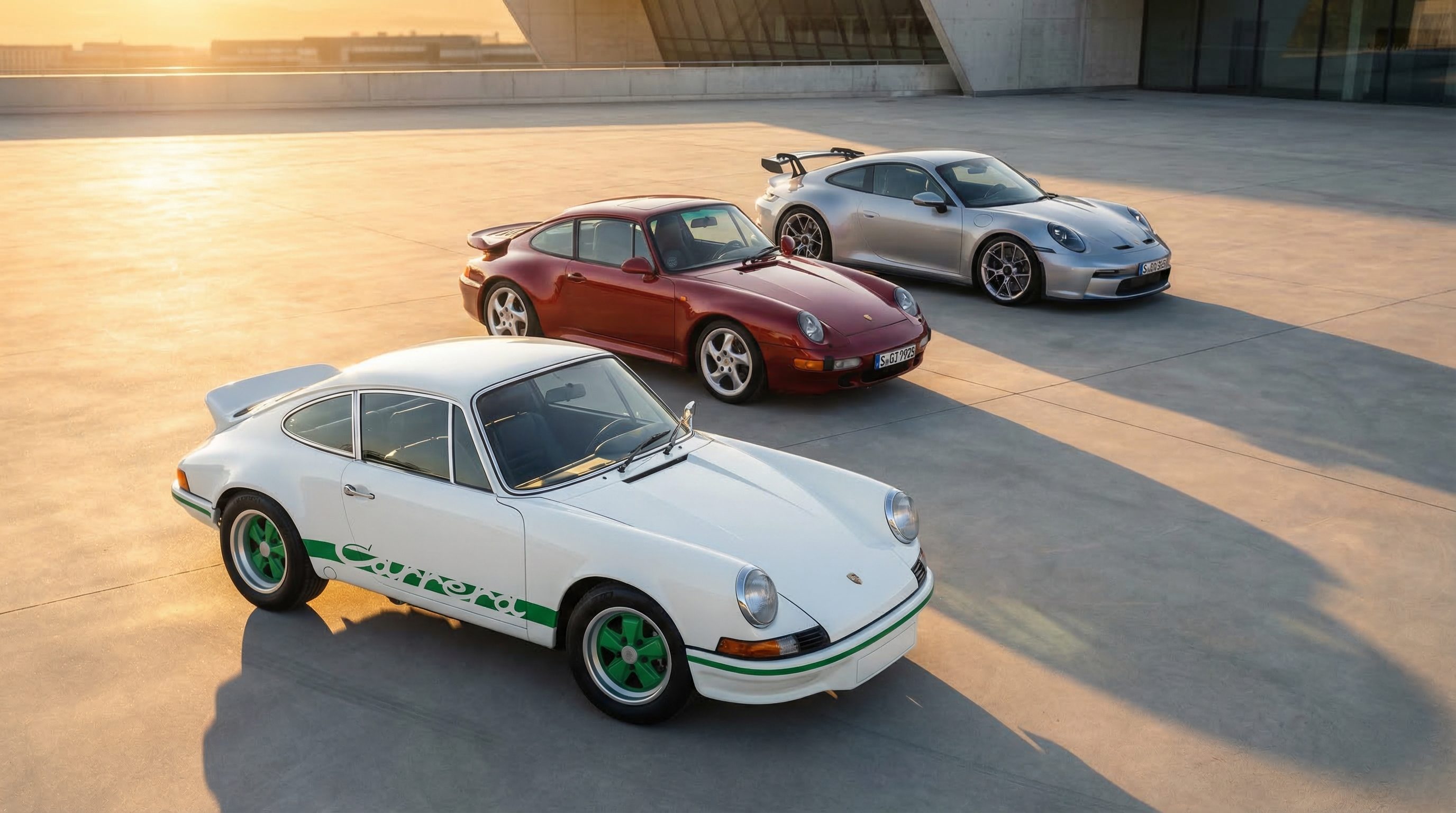
The Porsche 911 has been in continuous production since 1964 — over sixty years of rear-engine, flat-six engineering that no other manufacturer has come close to replicating. Whether you're a first-time collector hunting for a weekend driver or a seasoned enthusiast adding to a stable, the 911 remains the definitive sports car investment.
At Axis Auto, we've sourced dozens of 911s for clients across Los Angeles — from air-cooled 3.2 Carreras to brand-new GT3s. Our vehicle sourcing service gives you access to dealer-only auctions, private collections, and off-market inventory that never hits the public listings. This guide distills everything we've learned about buying smart in the 911 market.
How This Guide Is Organized
We cover every major 911 generation in chronological order, from the original 911 through the current 992. For each generation, you'll find:
- Production years and key model variants
- What makes it special — the driving character and collector appeal
- What to look for — common issues, red flags, and must-inspect items
- 2026 market pricing — realistic ranges based on current BaT results and dealer inventory
- Our verdict — who each generation is best suited for
Porsche 911 Generations at a Glance
| Generation | Years | Engine | 2026 Price Range |
|---|---|---|---|
| Classic 911 (901/911) | 1964–1973 | 2.0–2.7L air-cooled flat-6 | $90K – $300K+ |
| G-Body / Impact Bumper | 1974–1989 | 2.7–3.2L air-cooled flat-6 | $45K – $180K |
| 964 | 1989–1994 | 3.6L air-cooled flat-6 | $55K – $200K |
| 993 | 1995–1998 | 3.6L air-cooled flat-6 | $65K – $350K |
| 996 | 1999–2004 | 3.4–3.6L water-cooled flat-6 | $25K – $120K |
| 997 | 2005–2012 | 3.6–3.8L water-cooled flat-6 | $40K – $200K |
| 991 | 2012–2019 | 3.0L twin-turbo / 4.0L NA flat-6 | $60K – $300K |
| 992 | 2020–present | 3.0L twin-turbo / 4.0L NA flat-6 | $95K – $400K+ |
Air-Cooled vs. Water-Cooled: The Great Divide
Before we dive into individual generations, let's address the question every prospective 911 buyer asks: air-cooled or water-cooled?
Air-cooled 911s (1964–1998) are the emotional choice. The mechanical symphony of the flat-six behind you, the analog steering feel, the direct connection to the road — these are the characteristics that built the 911 legend. They're also the cars that have appreciated the most dramatically over the past two decades.
Water-cooled 911s (1999–present) are objectively faster, more refined, and far easier to live with daily. They have air conditioning that works, they don't overheat in LA traffic, and a 997.2 Carrera S will outperform a 993 Turbo on any track. For many buyers, the water-cooled era represents the best performance-per-dollar in the sports car world.
Air-Cooled vs. Water-Cooled: Quick Comparison
Air-Cooled (1964–1998)
- + Strongest appreciation potential
- + Pure analog driving experience
- + Iconic sound and character
- + Easier for owners to wrench on
- – Higher maintenance costs
- – Less daily-driver friendly in hot climates
- – Significantly higher entry price
Water-Cooled (1999–present)
- + More performance per dollar
- + Better as a daily driver
- + Modern safety and technology
- + Lower entry price (especially 996)
- – Less mechanical character
- – IMS bearing issue (996/early 997)
- – Slower appreciation (though 997.2+ is rising)
Our advice: buy the car that excites you. If you dream about the mechanical rawness of an air-cooled 911, a perfect 997 GTS won't scratch that itch no matter how fast it is. And if you want to actually drive your 911 hard on canyon roads every weekend, an air-cooled car in LA summer traffic might test your patience.
Classic 911 (1964–1973): The Origin
The car that started it all. Designed by Ferdinand "Butzi" Porsche as the successor to the 356, the original 911 established every design principle that would define the model for the next six decades: rear-mounted flat-six engine, 2+2 seating, and that unmistakable silhouette.
Key Models
- 911 S (1967–1973): The sport variant with more horsepower, upgraded suspension, and Fuchs alloy wheels. The most sought-after non-RS classic 911.
- 911 T (1968–1973): The "Touring" base model. Don't let the name fool you — these are still brilliant driver's cars and represent the best entry point into the classic 911 world.
- 911 E (1969–1973): The "Einspritzung" (fuel injection) model, slotting between T and S. Mechanically sophisticated with Bosch fuel injection.
- Carrera RS 2.7 (1973): The holy grail. Only 1,590 built. Lightweight body, ducktail spoiler, 210 hp flat-six. Six-figure minimum, seven-figure for exceptional examples.
What to Look For
- Rust: The number-one enemy. Check the battery box area, front trunk floor, rocker panels, kidney areas behind the rear wheels, and windshield frame. Any classic 911 that hasn't had rust addressed is a ticking time bomb in a California coastal climate.
- Matching numbers: Engine and transmission numbers that match the Porsche Certificate of Authenticity (CoA) add 20-40% to the value. Always order a CoA from Porsche before buying.
- Chain tensioner conversion: Early 911s used Carrera-style chain tensioners prone to failure. Many have been updated to the later hydraulic type. Verify this has been done.
- Previous restoration quality: A bad restoration is worse than no restoration. Look for consistent panel gaps, original-spec paint thickness, and proper undercoating.
2026 Market Pricing
- 911 T: $90,000 – $150,000 for clean, running examples
- 911 S: $130,000 – $250,000 depending on year and condition
- Carrera RS 2.7: $800,000 – $1,500,000+ (if you can find one)
Our verdict: Classic 911s are for collectors who appreciate automotive history and don't mind paying a premium for the experience. If you're buying purely to drive, the G-body generation offers a similar air-cooled experience at a fraction of the cost.
G-Body / Impact Bumper 911 (1974–1989): The Sweet Spot
The longest-running 911 generation earned its "impact bumper" nickname from the accordion-style bumpers mandated by US safety regulations. What looked controversial in 1974 is now considered an iconic design element. This is where many 911 enthusiasts believe the best values live.
Key Models
- 911 SC (1978–1983): The "Super Carrera" is widely regarded as the best-value air-cooled 911. The 3.0L engine is robust and well-sorted, benefiting from years of development. Ferry Porsche himself called it "the best 911 ever made."
- 3.2 Carrera (1984–1989): The evolution of the SC with a 3.2-liter engine producing 207 hp. The last of the pure, non-turbo, impact-bumper 911s. Many consider it the ultimate driver's 911.
- 930 Turbo (1976–1989): The widowmaker. The first turbocharged 911 brought savage boost and terrifying turbo lag. The wide-body design is unmistakable. Values have soared.
What to Look For
- Oil leaks: Some seepage is normal on air-cooled engines. Heavy leaks from the cam covers, case halves, or oil return lines indicate deferred maintenance.
- Timing chain tensioner: The Carrera 3.2 uses a different tensioner than early cars, but it still requires attention. Listen for chain rattle on cold start.
- Valve guides: Worn valve guides cause oil burning and blue smoke on deceleration. Replacement is an engine-out job and can cost $5,000–$8,000.
- Galvanized body: Starting in 1976, Porsche began galvanizing body panels. Cars from 1976+ are significantly more rust-resistant than earlier 911s, though rust can still appear around window seals and battery boxes.
- 930 Turbo specifics: Check turbo wastegate function, boost gauge accuracy, and intercooler condition. Turbo rebuilds run $3,000–$5,000.
2026 Market Pricing
- 911 SC: $45,000 – $85,000 for clean coupes; Targas run $5K–$15K less
- 3.2 Carrera: $55,000 – $110,000; Targas and cabriolets slightly less
- 930 Turbo: $100,000 – $180,000 for standard cars; special editions significantly more
Our verdict: The G-body era is our top recommendation for buyers who want an authentic air-cooled 911 experience at a (relatively) accessible price. The 3.2 Carrera in particular offers the best combination of reliability, driving pleasure, and value retention. This is the generation we source most frequently for our clients.
964 (1989–1994): Modern Meets Classic
The 964 was an 85% new car disguised in classic 911 clothing. It introduced coil-spring suspension (replacing torsion bars), ABS brakes, power steering, and all-wheel drive for the first time. Purists initially criticized it for being "too modern," but the 964 has become one of the most desirable 911 generations.
Key Models
- Carrera 2: Rear-wheel drive, the purist's choice. Available as coupe, Targa, and cabriolet.
- Carrera 4: The first all-wheel-drive 911. Heavier and more complex, but all-weather capable.
- RS (1992): A lightweight, track-focused variant. Deleted sound deadening, thinner glass, and a more aggressive tune. Values have climbed dramatically — $200K+ for clean examples.
- Turbo 3.6 (1993–1994): The most refined of the air-cooled Turbos. 360 hp, wide body, and the last of the air-cooled turbo 911s.
What to Look For
- Dual-mass flywheel: The 964 introduced a dual-mass flywheel that's expensive to replace ($2,500–$4,000). Listen for rattling at idle in neutral.
- Oil leaks from chain housing: The Carrera 2 and 4 are known for oil leaks from the timing chain housing gasket. This is an engine-out repair — budget $3,000–$5,000 if it hasn't been addressed.
- Power steering pump: These can leak and fail. Replacement is ~$1,500 including labor.
- Carrera 4 transfer case: The all-wheel-drive system is complex and expensive to repair. Check for smooth engagement and no unusual noises.
2026 Market Pricing
- Carrera 2 Coupe: $55,000 – $100,000
- Carrera 4: $50,000 – $90,000 (slightly less due to complexity)
- RS: $180,000 – $350,000
- Turbo 3.6: $130,000 – $200,000
Our verdict: The 964 is the sweet spot of air-cooled 911 ownership — modern enough to drive daily (power steering, ABS) but still analog enough to feel connected. It's appreciated significantly in recent years, but still offers better value than the 993 for a very similar driving experience.
993 (1995–1998): The Last Air-Cooled
The 993 carries an almost mythical status: the last air-cooled 911. Porsche knew this was the final generation to use the legendary air-cooled flat-six, and they made it count. The 993 is widely considered the most refined and reliable air-cooled 911 ever built, with a multi-link rear suspension that finally tamed the 911's notorious snap oversteer.
Key Models
- Carrera (C2/C4): The base models with 272 hp. The C2 coupe with a 6-speed manual is the classic configuration.
- Carrera S: Wider Turbo-look body with standard rear-wheel drive. The gentleman's choice.
- Carrera 4S: Wide body with all-wheel drive. One of the most sought-after 993 variants.
- Turbo: The first twin-turbo 911, producing 408 hp. All-wheel drive, wide body, and brutal acceleration.
- GT2: Rear-wheel-drive version of the Turbo with 430 hp. The rarest and most valuable production 993.
- Turbo S: Only 183 built. 450 hp, carbon/kevlar seats, yellow calipers. Seven-figure territory.
What to Look For
- Cylinder head studs: Some 993 engines (particularly 1995 models) had issues with cylinder head studs pulling from the case. This is a catastrophic failure requiring engine rebuild ($15,000–$25,000). Ask about engine history and any preventive re-studding.
- Transmission synchros: Second gear synchro wear is common on 6-speed cars, especially those driven hard. Test by downshifting into second at moderate speed — any grinding or resistance means synchro work is needed ($2,000–$4,000).
- Variocam system: The 993 introduced Porsche's variable valve timing. Listen for chain rattle on startup, which can indicate worn Variocam chain tensioners.
- Aftermarket modifications: 993s are heavily modified in the enthusiast community. Verify that any modifications are quality work (RUF, TechArt) rather than cheap bolt-ons.
2026 Market Pricing
- Carrera Coupe: $65,000 – $120,000
- Carrera S / 4S: $90,000 – $175,000
- Turbo: $150,000 – $250,000
- GT2: $500,000 – $900,000
Our verdict: The 993 is the "if you can only buy one air-cooled 911" answer. It drives better than the 964, it's more refined than the G-body, and it carries the cachet of being the final air-cooled generation. Prices have stabilized after a spike in 2021-2022, making 2026 a reasonable time to buy. The Carrera 4S in particular is a phenomenal driver that holds value exceptionally well.
996 (1999–2004): The Controversial One
The 996 changed everything — and not everyone was happy about it. The first water-cooled 911 introduced a new design language with the polarizing "fried egg" headlights, a completely new flat-six engine, and a dramatically more modern interior. It was a massive leap in capability, but it broke from 911 tradition in ways that enthusiasts are still debating.
Here's the truth: the 996 is the most undervalued 911 generation in 2026. The IMS bearing stigma has depressed prices to the point where you can buy a world-class sports car for the price of a loaded Toyota Camry.
Key Models
- Carrera (3.4L): 1999–2001, 300 hp. The first water-cooled 911. Most affected by the IMS stigma.
- Carrera (3.6L): 2002–2004, 320 hp. Upgraded engine with slightly better IMS bearing design.
- GT3 (1999/2004): The track weapon. Naturally aspirated, motorsport-derived engine, and no IMS bearing issue. One of the greatest driving machines ever built.
- Turbo: 415–450 hp, all-wheel drive, twin-turbo Mezger engine (no IMS issue). A genuine supercar killer.
- GT2: Rear-wheel drive, 462 hp, no traction control. The most hardcore water-cooled 911 of its era.
The IMS Bearing: Separating Fear From Fact
The Intermediate Shaft (IMS) bearing is a sealed bearing inside the engine that supports the intermediate shaft driving the camshafts. When it fails, metal debris contaminates the engine — typically requiring a complete rebuild ($15,000–$25,000).
IMS Bearing: What You Actually Need to Know
- Failure rate: Estimated at 5-8% over the car's lifetime. Significant, but not the guaranteed failure the internet suggests.
- Most affected: 2000–2001 models with the dual-row bearing. 2002–2005 models switched to a single-row bearing that's actually more failure-prone.
- The fix: An IMS bearing retrofit (LN Engineering or similar) costs $2,000–$3,500 and is typically done during clutch replacement. Once replaced, the issue is permanently solved.
- Not affected: GT3, Turbo, and GT2 models use the Mezger engine, which has a different design and no IMS bearing issue.
- Our advice: Budget for the IMS retrofit. Factor it into the purchase price. A $30,000 996 with a $3,000 IMS fix is still a $33,000 Porsche 911 — a remarkable value.
2026 Market Pricing
- Carrera: $25,000 – $45,000 (the best entry point to 911 ownership)
- Carrera S (996.2): $35,000 – $55,000
- GT3: $85,000 – $120,000
- Turbo: $55,000 – $85,000 (incredible value for the performance)
Our verdict: If you want to drive a 911 — really drive it, every day, without worrying — the 996 is the smartest buy in the market. Yes, budget for the IMS fix. Yes, the headlights are an acquired taste. But the car beneath is a genuine Porsche 911 with 300+ horsepower, world-class handling, and a maintenance cost structure that won't bankrupt you. The Turbo in particular (with the bulletproof Mezger engine) is arguably the best performance value in the used sports car market.
997 (2005–2012): The Modern Classic
The 997 fixed everything the 996 got wrong. The round headlights returned, the interior quality improved dramatically, and the driving dynamics took another leap forward. The 997 is widely considered the "Goldilocks" 911 — modern enough to be genuinely comfortable and reliable, but analog enough to provide a connected driving experience that later generations are criticized for losing.
Key Models
- Carrera (997.1, 3.6L): 2005–2008, 325 hp. Beautiful car, but shares the IMS concern with the 996 (same engine family).
- Carrera (997.2, 3.8L DFI): 2009–2012, 345 hp. New direct fuel injection engine with no IMS bearing. The one to buy.
- Carrera S: Both 997.1 (355 hp) and 997.2 (385 hp). Wider rear track, larger brakes, sport exhaust.
- GTS: 997.2 only (2011–2012). 408 hp, center-lock wheels, wide body, Alcantara interior. Many consider it the ultimate naturally aspirated 911.
- GT3 / GT3 RS: Track-focused, Mezger engine (no IMS), 415–450 hp. The RS is one of the most celebrated 911s ever made.
- Turbo / Turbo S: 500–530 hp. Mezger engine. Devastatingly fast and surprisingly refined.
What to Look For
- 997.1 IMS bearing: Same issue as the 996. The single-row bearing used in 2005–2008 models is actually more failure-prone than the 996's later bearing. Get it replaced. The 997.2 (2009+) does NOT have this issue.
- Bore scoring (997.1): Some 997.1 engines develop cylinder bore scoring — scratches in the cylinder walls that cause oil consumption and eventual engine failure. Listen for a faint ticking at idle and check oil consumption. This is an engine-out repair.
- PDK vs. manual: The 997.2 introduced Porsche's PDK dual-clutch transmission. It's faster than the manual, but manual 997s command a 10-15% premium in the collector market.
- PASM (active suspension): Check that all modes work and there's no clunking from the dampers. Replacement is ~$3,000 per axle.
2026 Market Pricing
- Carrera (997.1): $40,000 – $65,000
- Carrera S (997.2): $65,000 – $100,000
- GTS: $110,000 – $150,000
- GT3 RS (997.2): $180,000 – $300,000
- Turbo S: $100,000 – $150,000
Our verdict: The 997.2 is our most-recommended water-cooled 911 for enthusiast buyers. No IMS bearing, no bore scoring, beautiful design, and a naturally aspirated engine that revs to 7,500 rpm with a sound that later turbocharged 911s can't match. The GTS is the pinnacle, but a clean Carrera S with a manual transmission and sport exhaust is one of the most satisfying sports cars you can buy at any price.
991 (2012–2019): The Technological Leap
The 991 was the first 911 built on an entirely new platform since the 996. It's longer, wider, lighter (thanks to aluminum construction), and dramatically more capable than the 997. The 991.1 was the last naturally aspirated base Carrera, while the 991.2 introduced forced induction across the range.
Key Models
- Carrera (991.1, 3.4L NA): 350 hp. The last naturally aspirated base 911.
- Carrera (991.2, 3.0L Twin-Turbo): 370 hp. Turbocharging brought more power and torque, but some enthusiasts miss the NA character.
- Carrera S: 400–420 hp depending on generation. The sweet spot of the range.
- GT3 (4.0L NA): 475–500 hp from a flat-six derived from the RSR race car. PDK or manual transmission.
- GT3 RS: 500–520 hp, rear-steer, magnesium roof, carbon fiber throughout. A street-legal race car.
- GT2 RS (2018): 700 hp, rear-wheel drive. The fastest road-going 911 ever at the time of its release. Nürburgring lap record holder.
- Speedster (2019): Limited to 1,948 units. 4.0L NA GT3 engine, manual only, heritage design. Already a collector piece.
What to Look For
- 991.2 turbo wastegate rattle: A common complaint on 991.2 turbo cars is a metallic rattle at idle from the wastegate actuators. It's not mechanically harmful but annoying. Porsche issued a technical service bulletin.
- Sport Chrono package: Highly desirable for resale. Cars without it can sell for $3,000–$5,000 less.
- PDCC (active anti-roll): When it works, it's brilliant. When it fails, repairs are $5,000+. Check for warning lights and test in Sport mode.
- Options matter enormously: A well-optioned 991 can be worth $15,000–$30,000 more than a base-spec car. Look for: Sport Chrono, PASM, sport exhaust, full leather, LED headlights.
2026 Market Pricing
- Carrera (991.1): $60,000 – $80,000
- Carrera S (991.2): $80,000 – $115,000
- GT3 Manual: $175,000 – $250,000
- GT3 RS: $200,000 – $325,000
- GT2 RS: $300,000 – $450,000
Our verdict: The 991 is a phenomenal sports car that suffers slightly from "too new to be classic, too old to be current" syndrome. This makes it a tremendous value proposition. A 991.2 Carrera S with a manual transmission and Sport Chrono is one of the best-driving 911s ever made, and you can buy one for about $100K — less than a new base Carrera. The GT3 variants are appreciating and represent both an incredible driving experience and a solid investment.
992 (2020–Present): The Current Generation
The current 911 is the most capable, most refined, and most technologically advanced in history. The 992 introduced a wider body across the entire range, a new 8-speed PDK, and digital gauges flanking the trademark center tachometer. It's also the generation that will eventually include hybrid and electric variants, making the pure-combustion 992 a future collector piece.
Key Models
- Carrera / Carrera S: 379–443 hp. The base 992 is faster than a 991 Turbo was.
- GTS: 473 hp, lightweight glass, Sport Chrono standard, Alcantara. The enthusiast's choice in the range.
- Turbo S: 640 hp. 0-60 in 2.6 seconds. Genuine hypercar performance in a daily-drivable package.
- GT3 (4.0L NA): 502 hp, 9,000 rpm redline, manual or PDK. The normally aspirated masterpiece.
- GT3 RS: 518 hp, active aerodynamics, DRS, swan-neck rear wing. The most extreme road-legal 911.
- S/T (2024): Manual only, 518 hp, lightweight, heritage-inspired. Limited production. Already trading above MSRP.
- Dakar: Rally-inspired, raised suspension, all-terrain tires. A wild card that's found an enthusiastic audience.
What to Look For
- Dealer markup reality: GT3, GT3 RS, and S/T models are allocated, not ordered. Expect $30,000–$100,000+ over MSRP on the secondary market, or build a relationship with a Porsche dealer for future allocations.
- Option spec is everything: On a new or recent 992, the options list can add $30,000–$60,000 to the price. PTS (Paint to Sample) colors, full bucket seats, and rear-axle steering all command premiums.
- PDK vs. manual: Manual take rates are low on standard models, making manual 992s relatively rare. This will matter for future value.
- Warranty status: Porsche's 4-year/50,000-mile warranty and CPO program are excellent. Verify warranty transfer eligibility.
2026 Market Pricing
- Carrera: $95,000 – $120,000
- GTS: $145,000 – $175,000
- Turbo S: $200,000 – $250,000
- GT3: $220,000 – $300,000
- GT3 RS: $300,000 – $400,000+
Our verdict: If you're buying a 992 to drive and enjoy, the GTS with a manual is the sweet spot. If you're buying for investment, the GT3 with a manual transmission will be the air-cooled 911 of the 2040s — the last of the naturally aspirated, manually shifted, analog-feeling 911s before electrification changes everything. Buy the best spec you can afford.
The Non-Negotiable: Pre-Purchase Inspection
Never buy a 911 without a pre-purchase inspection (PPI). This is non-negotiable regardless of generation, mileage, or how good the seller's photos look. A proper PPI costs $300–$600 and can save you $10,000–$50,000 in undiscovered issues.
What a Good PPI Covers
- Compression and leakdown test (essential for air-cooled cars)
- Oil sample analysis (reveals bearing wear, coolant contamination)
- Suspension component inspection (bushings, ball joints, tie rods)
- Brake measurement (rotor thickness, pad life, caliper function)
- Underbody inspection on a lift (rust, leaks, accident damage)
- Electrical system check (windows, locks, gauges, warning lights)
- Paint thickness measurement (reveals prior bodywork)
- Service history verification
In Los Angeles, we recommend TRE Motorsports, Elephant Racing, or any Porsche-specialist independent shop. Avoid general mechanics — 911s have specific quirks that generalists miss.
Where to Find the Right 911
Online Auctions
- Bring a Trailer: The largest selection of enthusiast 911s, with transparent pricing and community vetting. See our BaT buying guide.
- Cars & Bids: Strong for modern 911s (996–992). Lower fees than BaT.
- RM Sotheby's / Gooding: For six- and seven-figure collector 911s.
Dealer-Only Auctions
Licensed dealers have access to wholesale auction inventory that the public can't see. Manheim, ADESA, and dealer-only auction houses regularly cycle 911s at 15-25% below retail. Learn more in our dealer auction guide.
Private Sales
Porsche Club of America (PCA) classifieds, Rennlist forums, and local PCA chapters are excellent sources for well-maintained 911s from knowledgeable owners.
Let Axis Auto Find Your Perfect 911
Our vehicle sourcing service gives you access to dealer-only auctions, private collections, and off-market inventory across California. Tell us what you're looking for — generation, spec, budget — and we'll find it, inspect it, and deliver it.
We've sourced air-cooled 3.2 Carreras, 993 Turbos, 997 GTS models, and everything in between for clients in Los Angeles, Orange County, and San Diego.
Start Your Search →Related Articles
About Axis Auto: Axis Auto is a licensed California dealership in Los Angeles specializing in enthusiast vehicles, Bring a Trailer auction preparation, bespoke car sourcing through dealer-only auctions, and luxury fleet rentals. With deep expertise in collector car marketing and dealer auction access, we help clients buy and sell exceptional automobiles in Los Angeles and throughout California.
Robert "The Curator" | Gev "The Deal-Maker" | Sev "The Authority"