For decades, dealer-only auto auctions have been the industry's best-kept secret: massive marketplaces where thousands of vehicles change hands daily at wholesale prices, completely hidden from the public eye. If you've ever wondered how dealerships acquire inventory or where trade-ins disappear to, the answer is dealer auctions.
At Axis Auto, we use our California dealer license to access exclusive wholesale auctions including Manheim, ADESA, OPENLANE, AVDA, and ACV. Our bespoke car sourcing service brings dealer auction access to private buyers who want exceptional vehicles at wholesale pricing. This guide reveals exactly how dealer auctions work and how you can benefit from insider access.
What Are Dealer Auctions?
Dealer auctions (also called wholesale auto auctions) are restricted marketplaces where licensed automotive dealers buy and sell used vehicles in bulk. Unlike public auctions like Copart or IAA where anyone can participate, dealer auctions require an active dealer license, dealer bond, AuctionACCESS registration, and auction membership.
Major Dealer Auction Companies
- Manheim — The industry giant, operating 70+ locations nationwide with 7+ million vehicles sold annually
- ADESA (Automotive Dealer Exchange Services of America) — a major dealer-only auction network with physical sales, Simulcast, and ADESA Clear timed digital auctions
- OPENLANE — Dealer-to-dealer digital wholesale marketplace connected to the broader ADESA and OPENLANE ecosystem
- ACV Auctions — Digital-only platform with rapid growth in online wholesale
- BacklotCars — Digital wholesale marketplace
- AVDA (Alliance of Valley Dealer Auctions) — Regional, Southern California focus
In California alone, major auction facilities operate in Los Angeles, Fontana, San Diego, Sacramento, Oakland, and Fresno. Los Angeles County has several facilities processing thousands of vehicles weekly.
Why Dealer Auctions Exist: The Vehicle Lifecycle
Understanding wholesale auto auctions requires understanding the vehicle lifecycle:
- New Car Purchase: Consumer buys a new car from a dealership and trades in their old vehicle.
- Trade-In Evaluation: The dealership evaluates the trade. If it's desirable (low miles, popular model, clean condition), they may retail it on their lot. If not, it goes to auction.
- Wholesale to Auction: The dealership consigns the vehicle to their preferred auction house. The car is transported, inspected, and prepped for sale.
- Auction Day: Licensed dealers bid on the vehicle. The highest bidder wins, typically paying wholesale market value.
- Dealer Inventory: The winning dealer adds the car to their retail inventory, performs reconditioning, and lists it at retail price.
The Wholesale-to-Retail Price Gap
The difference between wholesale auction price and retail asking price can range from $2,000 to $10,000+ depending on the vehicle. As a licensed dealer, Axis Auto navigates this gap on behalf of our clients, passing the savings along instead of marking up to retail.
Who Sells at Wholesale Auto Auctions?
- New Car Dealerships (60-70% of volume): Trade-ins that don't fit their brand or inventory profile
- Rental Car Companies: Enterprise, Hertz, and Avis selling retired fleet vehicles (typically 30,000-50,000 miles)
- Lease Companies: Off-lease vehicles returned at lease-end
- Financial Institutions: Repossessions and loan defaults
- Fleet Companies: Corporate fleets retiring vehicles
- Other Dealers: Dealers selling aged inventory or vehicles that didn't sell retail
This means you're accessing the same inventory pool that dealerships use to stock their lots, often before it reaches retail consumers.
How Dealer Auction Bidding Works
Physical Auction Lane
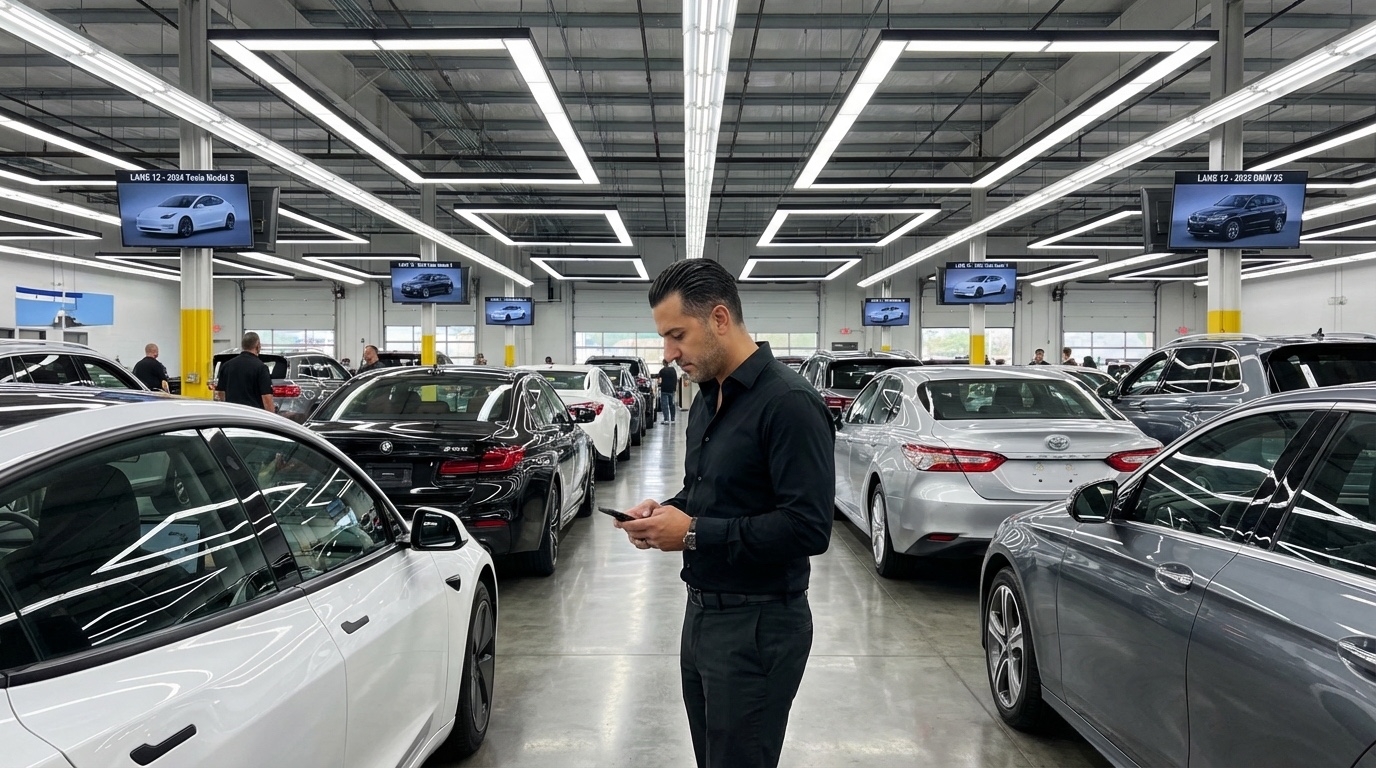
Traditional dealer auctions operate like fast-paced live sales with an auctioneer and dozens of vehicles crossing the block every hour.
- Pre-Sale Inspection: Vehicles are displayed in massive lots. Dealers arrive early (sometimes 4 to 6 hours before sale) to inspect inventory: start the car, check fluids, inspect the interior, and review condition reports.
- Condition Reports: Each vehicle has a detailed condition report noting mechanical issues, body damage, odometer reading, title status, and seller disclosures.
- Lane Time: Vehicles enter the auction lane at scheduled times. An auctioneer starts bidding at a suggested opening bid.
- Rapid-Fire Bidding: Bidding happens FAST. Auctions process 100 to 150 vehicles per hour. You have 60 to 90 seconds to inspect the car on the block, make your decision, and bid.
- Sold or IF: If bidding meets the seller's reserve, the vehicle sells. If not, it's marked "IF" (insufficient bid). Post-sale negotiation may follow.
- Post-Sale: Winning bidders pay immediately via wire transfer or dealer draft, typically picking up vehicles within 3 to 5 business days.
Digital Dealer Auctions (Increasingly Popular)
Platforms like ACV, OPENLANE, ADESA Clear, and Manheim Digital combine technology with traditional wholesale:
- High-resolution photos (100-300 images)
- Detailed condition reports with paint depth readings
- Undercarriage photos and videos
- Mechanical inspections and CarFax/AutoCheck reports
- Live or timed bidding online
- Arbitration protection (return windows if condition is misrepresented)
Digital auctions now represent 40 to 50% of wholesale transactions. They allow dealers nationwide to bid on vehicles without physical attendance. Many physical auctions also offer simulcast bidding, where you can watch the live lane online and bid remotely while other dealers bid in-person.
Dealer Auction Fees and Costs
Buyer Fees (Typical)
- Auction fee: $300-600 (varies by vehicle price, auction, and sale lane)
- Documentation fee: $100-200
- Title processing: $50-150
- Transportation (if needed): $200-800 depending on distance
Example: You win a bid at $25,000. Total out-the-door might be $25,850 after fees.
Additional Costs to Consider
- Reconditioning (detail, minor repairs): $300-1,500
- Major mechanical repairs: varies widely
- Smog certification (California): $50-100
- Registration and title transfer: varies by state
Auction Grading and Condition Reports
Auctions use standardized grading systems to communicate vehicle condition:
Manheim Condition Report Scale
Grade 1.0-1.9: Exceptional condition, like-new
Grade 2.0-2.9: Clean condition, minor imperfections
Grade 3.0-3.9: Average condition, noticeable wear
Grade 4.0-4.9: Rough condition, significant issues
Grade 5.0+: Poor condition, needs major work
Condition reports are directional, not guarantees. Smart dealers always inspect in person when possible. Digital auctions typically offer stronger guarantees and arbitration.
Title Types at Dealer Auctions
Understanding title status is critical when buying at wholesale auto auctions:
- Clean Title: Standard, no issues. Vehicle can be registered normally.
- Salvage Title: Insurance company declared total loss. Reduces value 30-50%.
- Rebuilt/Reconstructed: Salvage vehicle that passed state inspection after repair. Can be registered but value remains reduced.
- Lemon Law Buyback: Manufacturer repurchased vehicle under lemon law. Must be disclosed.
- True Mileage Unknown (TMU): Odometer discrepancy or unknown history. Risky.
- Flood Damage: Water damage, often from hurricanes. Hidden electrical and mechanical issues.
At Axis Auto, we focus on clean title vehicles unless a client specifically requests otherwise with full disclosure. The risk and reduced resale value of salvage or rebuilt titles rarely justify the savings for enthusiast vehicles.
Arbitration and Buyer Protection at Dealer Auctions
Dealer auctions offer arbitration policies to protect buyers from undisclosed issues:
- Physical auctions: 3-5 day window for major mechanical or structural issues
- Digital auctions: 7-10 days with more comprehensive coverage
- Frame or structural damage: Extended arbitration, often 30-90 days
Arbitration covers undisclosed mechanical issues, frame damage, title problems, and odometer discrepancies. It does not cover issues visible during inspection, minor cosmetic problems, or buyer's remorse.
Dealer Auction Prices vs. Retail: The Real Math
Real-World Pricing Example
2021 Porsche 911 Carrera S
Retail asking price (dealer lot): $135,000
Trade-in value (what dealer offers): $115,000
Dealer auction wholesale: $118,000-122,000
Winning auction bid: $119,500
Auction fees: $800
Reconditioning: $600
Dealer total cost: $120,900
With Axis Auto sourcing, we bid $119,500, pay $800 in fees, charge our sourcing fee, and deliver at $125,000-128,000. You save $7,000-10,000 vs. retail and get the exact spec you want.
Los Angeles and California Dealer Auctions
California dealer auctions have unique characteristics that make them valuable for enthusiast vehicle sourcing:
Advantages
- Massive inventory volume (California is the largest auto market)
- Strict emissions standards mean well-maintained vehicles
- Premium vehicles are common (strong luxury market in LA and San Francisco)
- Multiple auction houses create competitive pricing
Los Angeles Market Specifics
LA auctions see exceptional luxury and exotic inventory due to the local market. High-line vehicles (Porsche, BMW, Mercedes, Range Rover) appear weekly. The entertainment and tech industries generate constant trade-in flow, creating regular opportunities for exceptional finds.
Do You Need a Dealer License to Buy at Auction?
Yes — dealer-only auctions like Manheim, ADESA, OPENLANE, and AVDA usually require dealer credentials, auction registration, and marketplace approval. These wholesale marketplaces are built for licensed dealers and auto brokers; private buyers generally cannot register, attend, or bid directly. For the dedicated licensing breakdown, read Do You Need a Dealer License to Buy at Auction?.
Obtaining a dealer license in California is not a casual shortcut for one purchase. The process can involve DMV approval, bonding, insurance, a compliant business location, auction registration, and ongoing compliance with DMV regulations and marketplace rules. For someone who wants to buy one or two vehicles at wholesale prices, the dealer license route usually makes little financial sense.
The practical alternative is to work with a licensed car broker who already holds a dealer license and has established auction access. A car broker acts as your representative at these dealer-only auctions, bidding on your behalf and passing the wholesale pricing directly to you. Instead of taking on licensing, registration, bonding, and compliance work yourself, you pay a flat car buying service fee and get immediate access to the same wholesale inventory. At Axis Auto, our California dealer license gives us direct bidding access at Manheim, ADESA, and auction networks nationwide — so you get dealer auction prices without needing a dealer license of your own.
How Axis Auto Sources Vehicles Through Dealer Auctions
Our bespoke car sourcing service provides dealer auction access without requiring your own license. For a deeper dive into the specific techniques we use to find undervalued vehicles, read our dealer auction sourcing strategy guide. Here's how the process works:
- Consultation: You tell us exactly what you're looking for (year, make, model, specs, condition, budget)
- Market Research: We analyze recent auction results, pricing trends, and inventory availability
- Auction Monitoring: We track upcoming auctions (Manheim LA, ADESA, OPENLANE, AVDA, and ACV) for matches
- Inspection: When a candidate appears, we inspect in person or review comprehensive digital reports
- Bidding: We bid on your behalf using our dealer credentials
- Acquisition: If we win, we handle payment, title work, and transportation
- Delivery: You receive your vehicle with complete documentation and transparent pricing
Common Dealer Auction Mistakes to Avoid
- Bidding Without Inspection: The car looked good in photos but had hidden hail damage. Always inspect or trust comprehensive reports.
- Ignoring Condition Reports: The report noted "Check Engine Light ON, Code P0420." The buyer ignored it, assuming it was minor. It needed a $1,800 catalytic converter.
- Emotional Bidding: Auction fever is real. Set a maximum bid and stick to it. There is always another car.
- Underestimating Reconditioning Costs: "It just needs a detail" became a $3,500 paint correction and interior repair.
- Skipping Title Verification: Assumed clean title. It was a lemon law buyback with diminished value.
- Missing Arbitration Deadlines: Discovered frame damage on day 8. Arbitration window was 5 days. No recourse.
- Ignoring Market Research: Paid $28,000 at auction. Retail value was $29,000. No margin for reconditioning.
Digital vs. Physical Dealer Auctions: Which Is Better?
Physical Auctions
Pros
- In-person inspection (start the car, test features)
- Immediate feedback and gut-check
- Relationship building with auction staff
- Sometimes better deals (fewer bidders on certain lots)
Cons
- Time-intensive (half-day commitment)
- Fast-paced, pressure environment
- Limited to geographic area
Digital Auctions
Pros
- Bid from anywhere in the country
- Better documentation (photos, reports, videos)
- Extended arbitration windows
- More time to research and decide
Cons
- Can't physically inspect (relying on reports)
- Increased competition (nationwide bidders)
- Photos may not show all issues
Axis Auto uses both. For high-value or complex vehicles, physical inspection is invaluable. For well-documented, lower-risk vehicles, digital auctions expand our inventory access dramatically.
Frequently Asked Questions About Dealer Auctions
Can I attend dealer auctions as a regular consumer?
No. Dealer auctions require an active dealer license and auction membership. However, services like Axis Auto provide access through licensed dealers.
Are wholesale auction vehicles worse quality than retail?
No. They're the same vehicles. Dealerships source their retail inventory from these auctions. You're simply accessing them at wholesale pricing before the retail markup.
How do dealer auction prices compare to retail?
Wholesale dealer auction prices are typically 10-20% below retail asking prices. The exact savings depend on vehicle type, condition, and market demand. Common vehicles see tighter margins; specialized or luxury vehicles often have larger price gaps.
How long does vehicle sourcing take?
It depends on specificity. Common vehicles (popular SUVs, sedans) appear weekly. Rare specs or collectibles may take weeks or months. We keep you updated throughout the process.
Do I need to be in California?
No. We can source vehicles nationwide and arrange shipping. California buyers benefit from our local expertise and in-person inspection capability at Los Angeles area auctions.
Real Client Results: Dealer Auction Sourcing Success Stories
Recent Axis Auto Sourcing Results
Porsche 911 Turbo S (2021)
Sourced from Manheim LA luxury lane. Retail comp: $215,000. Our total cost to client: $198,500. Client saved $16,500.
BMW M8 Competition (2020)
Sourced from ADESA Digital. Retail comp: $98,000. Our total cost to client: $88,200. Client saved $9,800.
Mercedes G63 AMG (2019)
Sourced from AVDA regional. Retail comp: $152,000. Our total cost to client: $143,000. Client saved $9,000.
Access Wholesale Dealer Auction Inventory
Axis Auto's bespoke car sourcing service in Los Angeles uses our California dealer license and auction relationships to find exactly what you're looking for at wholesale pricing. Tell us what you want, and we'll find it.
Related Articles
About Axis Auto: We're a licensed California dealership in Los Angeles specializing in dealer auction access, full-service Bring a Trailer consignment and auction support, bespoke vehicle sourcing, and luxury fleet rentals. With insider knowledge of wholesale markets and enthusiast vehicle expertise, we help clients in Los Angeles and nationwide acquire exceptional automobiles at wholesale pricing.
Robert "The Curator" | Gev "The Deal-Maker" | Sev "The Authority"